
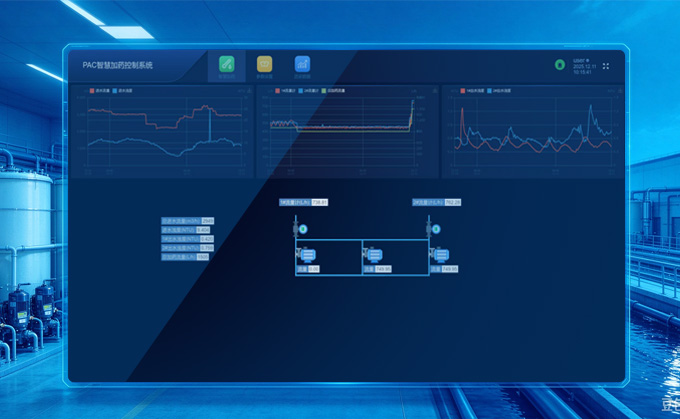
Suitable for: Water Plant Disinfection Solutions, Small-scale Regional Water Supply Solutions (Pipeline Booster Chlorination)
"Pre – Main – Booster" Multi-point Coordinated Smart Control Logic:
Calculates the required dosage for pre-oxidation based on raw water flow rate, ammonia nitrogen, and microbial indicators.
Combines pre-chlorination performance (residual chlorine at the clear water tank inlet) with hydraulic retention time and reaction environment (temperature) in the clear water tank. Uses an LSTM model to predict residual chlorine at the clear water tank outlet and dynamically adjusts the main chlorination dosage.
Based on finished water residual chlorine feedback and distribution network flow rate, precisely calculates the booster chlorine dosage to ensure residual chlorine compliance at network terminals.
 Sensing Layer
Raw water / finished water flow meters, residual chlorine analyzers, temperature sensors, pH and ammonia nitrogen instruments.
 Decision Layer
Smart dosing main controller (edge computing gateway with built-in multi-point chlorination software package).
 Execution Layer
Chlorination metering pumps (variable-frequency control), motorized control valves.
 Monitoring Layer
Chlorine leak alarm, emergency shut-off, safe discharge device.
 Software Environment
Windows platform support; data storage interval ≤5 minutes; historical data retention ≥1 year.
 Hardware Requirements
Dedicated industrial controller or high-performance IPC.
 Site Coordination
The chlorination room must have complete safety protection facilities (ventilation, flushing, alarms).
|
Comparison |
jonzoSmart Chlorination Control Software |
Conventional Single-loop Residual Chlorine Feedback Control |
|
Control Strategy |
Pre–Main–Booster multi-point coordination; LSTM model predicts future residual chlorine |
Controls only based on current residual chlorine feedback, severe lag |
|
Handling Time Delay |
Pre-calculates the impact of clear water tank retention time, precise prediction |
Cannot handle large process delays in water plants |
|
Chemical Consumption |
More refined control; typical projects save over 6% in chemicals |
Often over-doses to ensure compliance |
|
Safety |
Full-process monitoring, equipment interlock, supports unattended operation |
Relies on manual inspection, slow response |
Suitable for: Water Plant Disinfection Solutions, Small-scale Regional Water Supply Solutions (Pipeline Booster Chlorination)
 Telephone:+86-13372145285
Address:No. 100, Guangqi Road, Science and Technology City, SND, Suzhou , Jiangsu Province, China
E-mail:jonzo@jonzo.cn
Telephone:+86-13372145285
Address:No. 100, Guangqi Road, Science and Technology City, SND, Suzhou , Jiangsu Province, China
E-mail:jonzo@jonzo.cn