
Suitable for: Smart Dosing Control Solutions for Water Plants
Collects raw water flow rate, turbidity, pH, and temperature → inputs into an LSTM water quality prediction model → predicts water quality changes for the next 30 minutes → calculates the baseline dosage.
Detects settled water turbidity and flocculation performance (characterized by floc morphology and streaming current) → calculates deviation from target values → corrects dosage through PID/MPC models.
Uses machine learning and floc image recognition (EfficientNet) to predict and analyze flocculation performance, dynamically adjusting model parameters for continuous "self-evolution."
 Sensing Layer
Inlet flow meter, turbidity meter, pH meter, temperature sensor; outlet turbidity meter, dedicated floc recognition camera, streaming current meter.
 Decision Layer
Smart dosing main controller (edge computing gateway with built-in alum dosing software package).
 Execution Layer
Variable-frequency metering pumps, pipeline mixer, smart agitator.
 Monitoring Layer
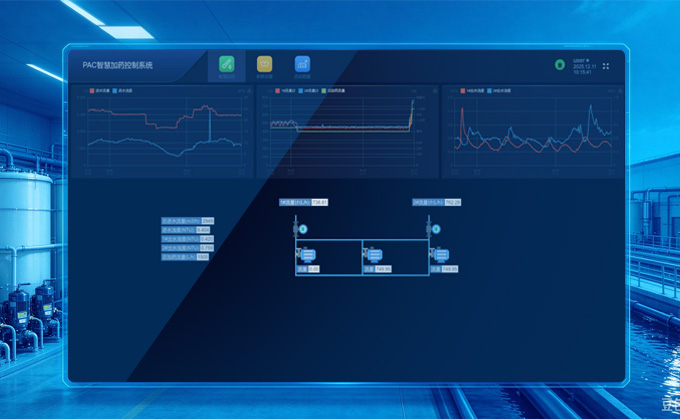
Central control room SCADA software (data dashboard, alarms, trend analysis).
 Software Environment
Windows/Linux operating system, supports mainstream SCADA software interfaces.
 Hardware Requirements
Industrial-grade IPC (i5 processor / 8 GB RAM / 128 GB SSD or above), dual network ports.
 Site Coordination
Corresponding water quality instruments must be installed in the dosing room and sedimentation tank.
|
Comparison |
jonzoSmart Turbidity Control Software |
Conventional PID Proportional Dosing / Manual Control |
|
Control Mode |
Feedforward + model prediction (looks ahead) |
Real-time feedback only (looks at present), severe lag |
|
Response to Fluctuations |
Proactively responds to raw water turbidity shocks |
Passive adjustment only after effluent exceeds limits |
|
Chemical Savings |
20%–35% savings vs. manual mode |
Experience-dependent, generally over-dosing |
|
Intelligence |
AI auto-modeling with floc recognition and self-learning |
Relies on manual sampling, testing, and adjustment |
Suitable for: Smart Dosing Control Solutions for Water Plants
 Telephone:+86-13372145285
Address:No. 100, Guangqi Road, Science and Technology City, SND, Suzhou , Jiangsu Province, China
E-mail:jonzo@jonzo.cn
Telephone:+86-13372145285
Address:No. 100, Guangqi Road, Science and Technology City, SND, Suzhou , Jiangsu Province, China
E-mail:jonzo@jonzo.cn