
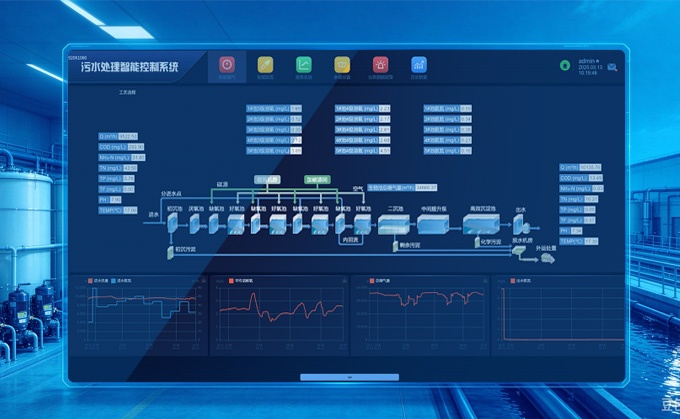
Suitable for: Smart control of biological systems in wastewater plants (carbon source and aeration)
"Feedforward Compensation – Cascade Feedback – Blower Coordination" Three-level Control:
Calculates theoretical air demand based on inlet flow rate, COD, and ammonia nitrogen load, and pre-adjusts blower frequency.
Uses aerobic tank DO analyzer and effluent ammonia nitrogen as feedback values, compares with target values, and performs precise correction.
Based on total air demand, automatically calculates and schedules the operating combination of multiple blowers (start/stop / variable-frequency) to ensure air supply matches demand.
 Smart Aeration Main Controller
Built-in aeration control software package.
 Sensing Instruments
Inlet flow meter, return flow meter, online COD/ammonia nitrogen analyzers, aerobic tank DO analyzer, effluent ammonia nitrogen analyzer.
 Execution Mechanisms
Blowers (with VFDs), air control valves.
 Aeration Equipment Status Monitoring
Air supply pipeline flow meter, pressure transmitter.
 Software Environment
High-performance central controller required to meet high computing power demand.
 Algorithm Development
Follows the "one plant, one strategy" principle; model calibration and validation are required for each specific wastewater plant (including no-load and load trial runs).
 Site Coordination
Ensure accurate and stable data from key instruments (DO, ammonia nitrogen, COD, inlet flow meter, return flow meter).
|
Comparison |
Jiuzheng Smart Aeration Control Software |
Conventional Single-feedback Control |
|
Control Variables |
Multi-parameter fusion (load + DO + ammonia nitrogen), more comprehensive |
Relies on a single data source only |
|
Control Mode |
Feedforward prediction + feedback correction + AI model (proactive) |
Passive response, lagged adjustment |
|
Energy Savings |
Significant; reduces energy consumption by 15%–25% |
Difficult to achieve optimal savings; often leads to over-aeration |
|
System Coordination |
Can coordinate with carbon source dosing system |
Operates independently, lacks coordination |
Suitable for: Smart control of biological systems in wastewater plants (carbon source and aeration)
 Telephone:+86-13372145285
Address:No. 100, Guangqi Road, Science and Technology City, SND, Suzhou , Jiangsu Province, China
E-mail:jonzo@jonzo.cn
Telephone:+86-13372145285
Address:No. 100, Guangqi Road, Science and Technology City, SND, Suzhou , Jiangsu Province, China
E-mail:jonzo@jonzo.cn